Culvert outlet
Verified Q, y, V
→
 Hydroism product 02 · v3.1
Culvert outlet · Energy dissipation · Erosion control
Concentrated flow can leave a culvert fast enough to erode the embankment, undermine the outlet, and threaten the road above. This application helps engineers design and review the entire protection path to the natural channel.
The downstream problem
The barrel may pass the flood. The road can still fail after the water leaves it.
On a mountain road, the outlet is often perched on or within a high fill. During a flood, a compact culvert flow becomes a high-energy jet. Uncontrolled, it can strip the outlet apron, mobilise fill material, and cut erosion back toward the structure.
The design therefore has to continue downstream: control the drop, dissipate energy, protect the bed and side slopes, and return flow to the natural drainage line without creating a new instability.
02 · The protection train
The app treats every element as part of the same energy path—not as an isolated detail.
Verified Q, y, V
→Control the elevation drop
→Contain the hydraulic jump
→Test free or submerged control
→Meet the exit-velocity criterion
03 · Hydraulic fundamentals
Only the governing ideas are shown here. Inside the application, each result is accompanied by its method, status, and application limit.
Q = A · VDischarge, depth, velocity, and effective hydraulic width are reconciled before downstream checks begin.
E = y + αV² / 2g · Fr = V / √(gy)Specific energy and Froude number reveal whether the outlet flow can create a damaging supercritical jet.
y₂ / y₁ = ½(√(1 + 8Fr₁²) − 1)Conjugate depth and the HEC-14 free-jump length estimate screen whether the basin can contain energy dissipation.
Q = Cw · B · H³ᐟ²Tailwater and the terminal sill are checked together; free overflow is separated from submerged-control review.
τ₀ = γ · y · SHEC-15 shear-based stability and application ranges keep gabion and riprap screening tied to documented limits.
Vfinal ≤ VallowableThe final velocity criterion closes the path from the culvert outlet to a safer transition into the natural wadi.
04 · Built for review
Inputs, proportional geometry, section-by-section energy results, and verification checks stay connected in one browser workspace.
Bring verified culvert-outlet flow from HY-8 or another hydraulic model.
Build the chute, transition, basin, and lining in their true downstream sequence.
Recalculate energy, Froude number, jump behavior, sill control, and exit velocity live.
Separate passes, failures, and items that still need engineering judgement.
Export a dimensionally proportional drawing and an editable DOCX report.
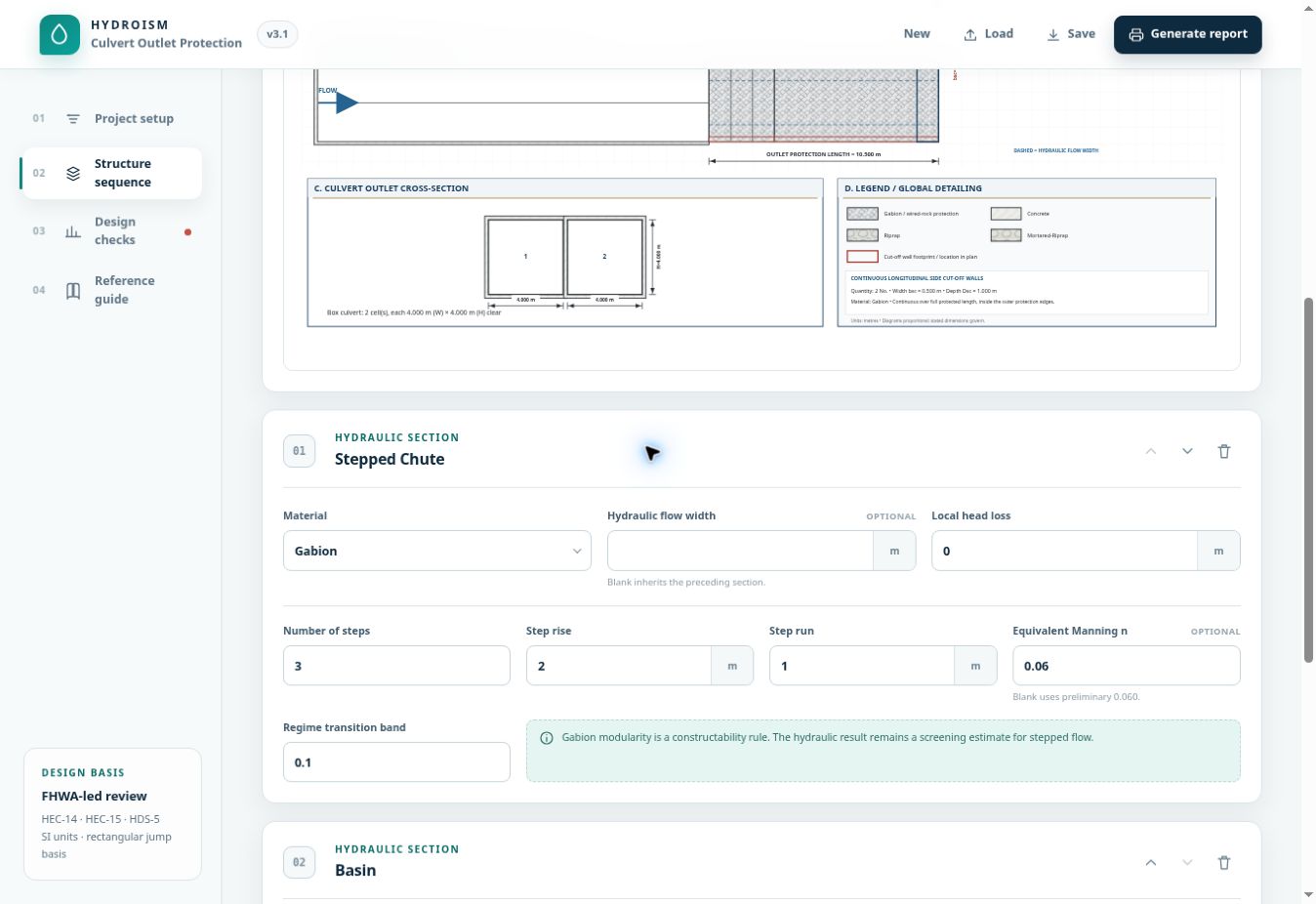

05 · Product walkthrough
From verified outlet data and the protection sequence to live hydraulic checks, documented limits, and the editable engineering report.
06 · Evidence and limits
This is a hydraulic design-support tool. Reinforcement, foundations, anchors, filters, basket wire, structural sill sizing, and geotechnical stability remain project-specific engineering tasks.
Hydroism Culvert Outlet Protection
Move from outlet flow to a reviewable protection concept, with the calculations and limits kept in view.